
How to Implement Salesforce in the Banking and Finance Industry?

Manish Kumawat
Last Updated on: 28 September 2026



Salesforce can help banks and financial services firms with customer data management, workflow automation, service improvements and connecting business systems. When implementing Salesforce for banking, the bank needs to fix the required features, configure the platform, integrate other systems, migrate the data, test the workflows and train the users. How you do it right depends on your bank’s goals, processes, data, users and compliance needs. You may think:
- Why do so many companies prefer Salesforce?
- How Salesforce helps banking and finance companies
- How do they implement Salesforce for banking?
So, here we will discuss all these aspects in detail and help you to implement Salesforce in the banking and finance industry. Let’s start!
Table of Contents
10 sectionsWhich Types of Financial and Banking Businesses Implement Salesforce Financial Services Cloud?
Salesforce Financial Services Cloud is useful to cover various needs of different financial industry businesses:

1Wealth Management Firms
When you implement Salesforce for banking, wealth managers and financial advisors get 100% clear details covering clients' financial profiles, risk tolerance and investment plans.
2Retail and Commercial Banks
When people as do banks use Salesforce, both retail and commercial banking services implement Salesforce for banking and get Financial Services Cloud. Salesforce banking projects help with better engagement of banking customers.
3Insurance Companies
Insurance industry professionals and teams use the Salesforce Financial Services Cloud to automate several procedures. It helps with policy renewals and streamlines the claims process without regular human intervention.
4Asset Management Companies
Asset managers and firms can access the latest and most accurate data analysis technologies. Get insightful knowledge about clients and develop strategies.
5Financial Advisors and Planners
Salesforce Financial Cloud services automate several operations within the platform and maintain client interactions. So the financial advisers and planners can make good plans on an individual basis and achieve efficiency.
6Credit Unions
Credit unions can use Salesforce Financial Services Cloud to send relevant offers and personal messages to members. This can help them stay connected with members and understand what they need. Salesforce Financial Services Cloud also helps credit unions offer services based on each member’s needs and manage financial processes.
7Hedge Funds and Private Equity Firms
When you implement Salesforce for banking, the analytics features of Salesforce Financial Cloud services help hedge fund managers. can improve client relationships and monitor portfolios always. This live evaluation helps to make wise plans for effective investment.
8Financial Technology (Fintech) Companies
Fintech companies use Salesforce Cloud to upgrade the client experience. This helps to provide customized services and effective financial solutions, which improve the reputation of Fintech companies.
9Brokerage Firms
Brokerage firms use the Salesforce Financial Services Cloud to manage client relationships, optimize trading procedures, and give their clients the latest market trend knowledge.
If you have any of the above-mentioned businesses and do not have a Salesforce partner, this is the right time to tie up with a top Salesforce service provider to implement Salesforce for banking.
Which Banks Use Salesforce?
Many people ask: do banks use Salesforce, does Bank of America use Salesforce, or how to implement Salesforce in a bank. Many leading banks and credit unions publicly document their use of Salesforce for customer relationship management, service, sales, data, onboarding, and related processes. Here we will see some of the examples and show that Salesforce is used in different banking environments. This also reveals the specific products and implementation approach varying by institution.
| Institution | Region | What they use Salesforce for | Source + date |
|---|---|---|---|
| Ponce Bank | USA |
|
Salesforce customer story, accessed Sep. 23, 2026 |
| Huntington Bank | USA |
|
Salesforce customer story, accessed Sep. 23, 2026 |
| Mascoma Bank | USA |
|
Salesforce customer story, accessed Sep. 23, 2026 |
| Kotak Mahindra Bank | India |
|
Salesforce customer story, accessed Sep. 23, 2026 |
| BCU | USA |
|
Salesforce customer story, accessed Sep. 23, 2026 |
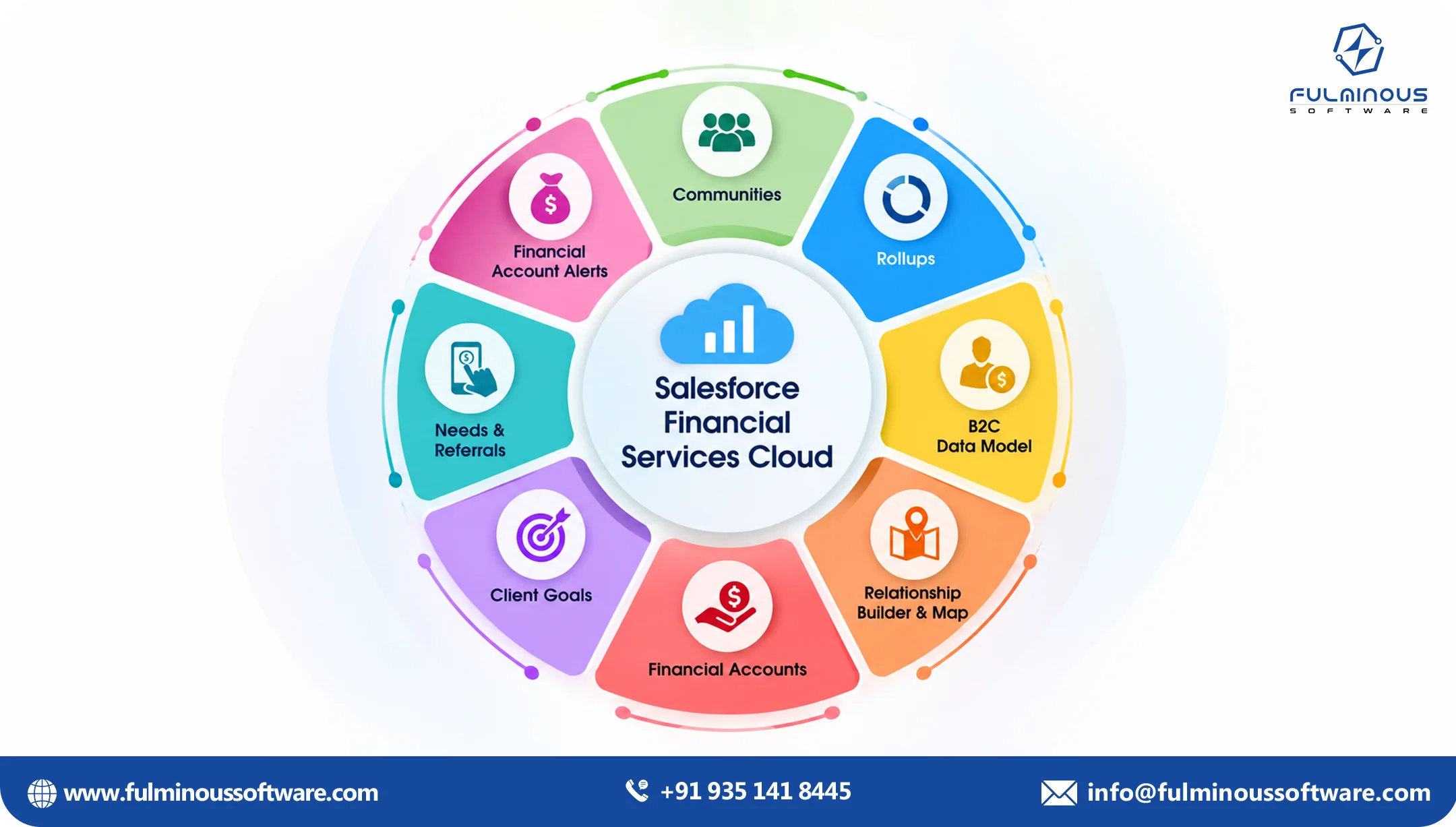
Uses of Implementing Salesforce for Financial and Banking Services Businesses
Salesforce is a common platform used by several banking and financial services. The exact use depends on the nature of the institution's existing systems and business workflow.

How Banks Use Salesforce
If you are having a financial institution implement Salesforce for banking so that you can bring customer information, sales activities, service requests and related processes into a strongly connected and synced CRM environment.
- Customer Relationship Management: Get a central view of customer information and interactions.
- Loan and Onboarding Workflows: Implement Salesforce for banking to manage various tasks in customer onboarding and lending-related workflows.
- Customer Service: Manage cases, customer requests, communication and follow-up activities.
- Data Integration: Link with core banking and other systems to bring synced business workflows.
How the Insurance Industry Uses Salesforce
Your insurance organization prefers Salesforce implementation for financial institutions and uses Salesforce for various tasks:
- Customer Service: Manage policyholder requests and interactions.
- Onboarding Workflows: Support structured workflows for new customers and service processes.
- Customer Data: Connected information can help employees understand customer relationships across different interactions.
How Wealth Management and Investment Firms Use Salesforce
Wealth management and investment organizations can go for a Salesforce implementation for financial institutions and use Salesforce to manage client relationships, advisor activities, service processes and connected data.
- Client Management: Advisors get client information, interactions, tasks and follow-ups.
- Financial Planning: Support workflows around client financial information and planning activities.
- Reporting: Get reporting and analytics capabilities to monitor activities, relationships and business processes.
- Third-Party Integration: Connect with approved external systems to exchange relevant business data.
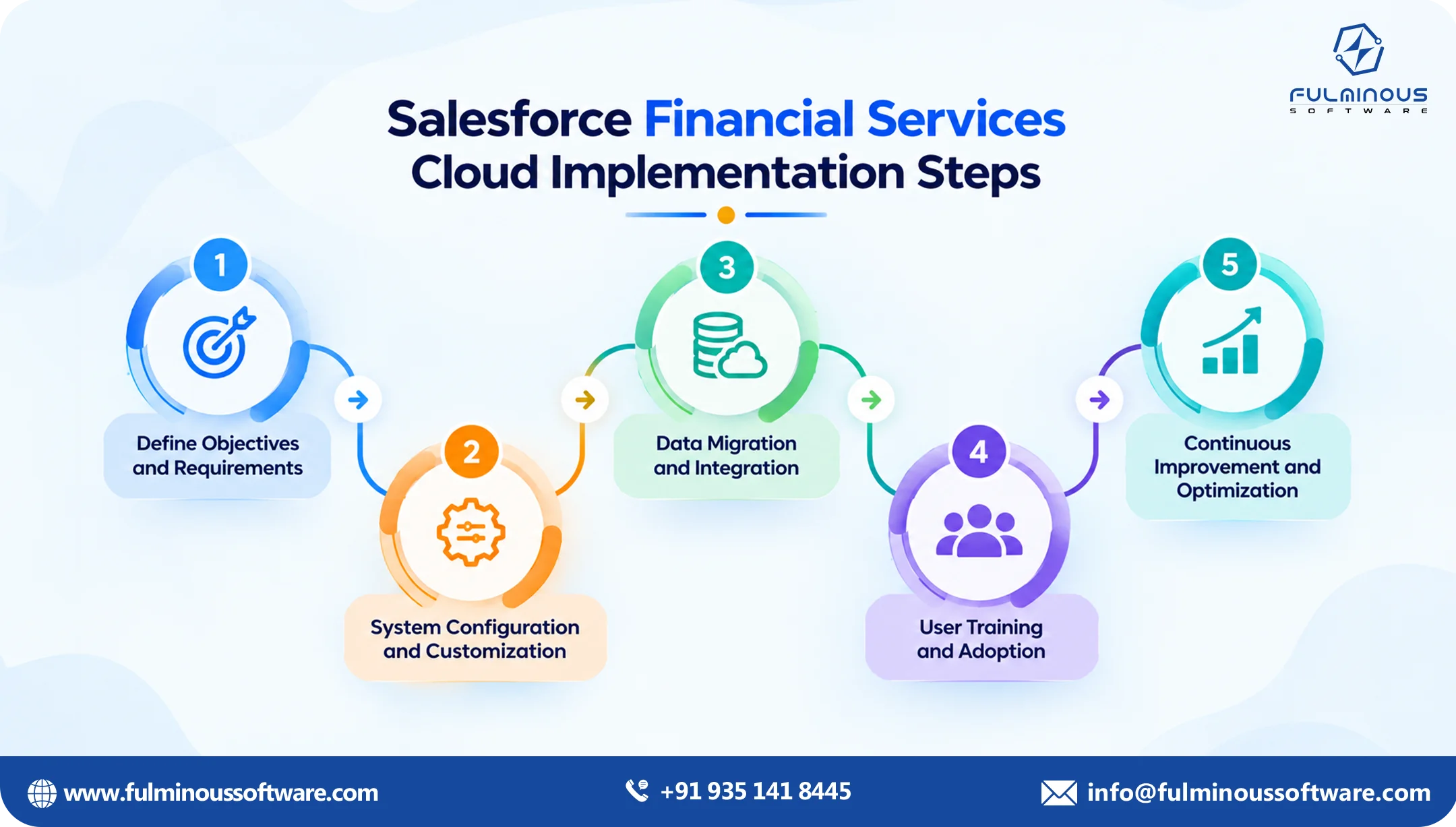
Steps to Implement Salesforce in the Banking and Finance Industry
Implementing Salesforce in a bank requires planning around business processes, customer data, existing systems, security, integrations, testing and internal approvals.
1Assess Business Requirements
You can start the implementation project by identifying the banking processes that Salesforce needs to support. You need to review customer management, service, onboarding, lending-related workflows, reporting, automation, user roles, data and existing applications.
Document regulatory and internal requirements before deciding how Salesforce should be configured. You can consult a leading Salesforce development consulting expert to complete this stage.
2Design the Salesforce Architecture
Here you need to fix the Salesforce products, data model, environments, permissions, integrations, and system responsibilities. The guidance of Salesforce experts will be useful in this task.
The design should also identify which information stays in the core banking system and which information is used in Salesforce.
3Configure Salesforce
Now configure the objects, fields, page layouts, workflows, permissions, automation, reports and other required Salesforce features.
Financial Services Cloud gives industry-specific data models and workflows for financial institutions. Salesforce currently refers to the product as Financial Services, while its documentation and customer stories continue to use Financial Services Cloud in several contexts.
4Integrate Existing Banking Systems
A bank normally has existing core banking, payment, lending, document, identity or other business systems.
Salesforce can connect with these systems through APIs, middleware and other integration methods. The integration design in banking Salesforce projects sets what data moves between systems, when it moves and which system remains the source
5Manage Banking Data
When you implement Salesforce for banking, review customer and account data before migration or integration. The Salesforce implementation for financial institutions should define:
- Data sources
- Required fields
- Data ownership
- Data quality rules
- Duplicate handling
- Migration requirements
- Data access
- Retention requirements
- Non-production data controls
Sensitive production data should not automatically be copied into development or test environments.
6Configure Security and Access
Banking implementations require careful control of who can access customer and business information.
The design can include profiles, permission sets, roles, sharing rules, field-level security, authentication controls, encryption where required, audit capabilities and access reviews.
The specific controls should be based on the institution's security and compliance requirements.
7Test the Implementation
Testing is a major stage in Salesforce banking projects and should cover multiple dimensions covering Salesforce configuration, integrations, data, workflows, permissions and user processes. A banking implementation may include:
- Functional testing
- Integration testing
- Data testing
- User acceptance testing
- Security testing
- Regression testing
- Deployment testing
Salesforce banking crm implementation testing requirements should follow the institution's internal change-control process.
8Train Users and Prepare for Go-Live
Users or employees need to understand how the new Salesforce implementation for financial institutions environment changes their daily work. So the Salesforce implementation for financial institutions also covers training. Training covers customer records, service cases, workflows, dashboards, permissions and other functions.
Before go-live, the Salesforce banking projects team should complete final testing, data checks and deployment approvals. Once everything is ready, the major process of Salesforce banking projects comes: launching.
9Monitor and Improve
Salesforce implementation process does not end at the go-live stage. As the user demands changes and ask for more convenient services, banks need to continue to update workflows, integrations, reports, security controls and user processes. Salesforce banking crm implementation experts will help you with proper improvement.
Their regular reviews can identify areas where automation, data quality, reporting or user experience improvement is needed. Salesforce implementation for financial institutions continues with this regular support.
What Does a Salesforce Banking Implementation Include?
A Salesforce banking implementation can include several connected work areas. The final scope depends on the institution and its existing technology environment.
| Implementation area | Typical activities |
|---|---|
| Requirements | Business process review, user requirements, system analysis |
| Architecture | Salesforce design, data model, environments, security |
| Configuration | Objects, fields, workflows, automation, pages |
| Integration | APIs, middleware, banking systems, third-party applications |
| Data | Data mapping, cleansing, migration, validation |
| Security | Roles, permissions, sharing, encryption, audit controls |
| Testing | Functional, integration, user acceptance, security testing |
| Deployment | Release planning, migration, production deployment |
| Training | User training, administrator training, documentation |
| Support | Issue resolution, improvements, monitoring, maintenance |
Salesforce and Legacy Core Banking Systems
Salesforce and a core banking system are generally used for different reasons. The core banking system is responsible for the core financial operations. Salesforce is mainly used for CRM, client engagement, sales, service, workflows and other related business processes.
A Salesforce implementation can hence hook up to an existing core banking system instead of replacing it. The integration has to indicate which system owns each type of data and how information is exchanged.
How Long Does Salesforce Banking Implementation Take?
There is no one-size-fits-all timeline for any bank. The implementation timeframe will vary based on the Salesforce products being used, number of users, business processes, integrations, data migration, customization, security needs, testing, compliance reviews, and internal approvals.
Salesforce, for example, says its Professional Services team implemented a large Salesforce framework for Kotak Mahindra Bank in eight months. This is an example of a documented project, not a typical timeline for all banking implementations.
What Do Banks Need Before Starting Salesforce Implementation?
Before starting the Salesforce implementation, a bank needs a clear view of its current tech environment and the changes it wants Salesforce to support. Key preparation for a bank before Salesforce implementation covers:
- Current Salesforce environment
- Existing CRM and banking systems
- Core banking platform
- Customer and account data
- Integration requirements
- User groups and access requirements
- Security controls
- Data migration needs
- Reporting requirements
- Internal approval process
- Testing requirements
- Change-management process
- Post-go-live support
So that banking and finance institutions can define the Salesforce implementation scope. This will be useful to move the process in a specific direction and stay within the budget.
Conclusion
Salesforce can help banking and financial services organizations with customer relationship management, service, onboarding, lending workflows, data management, automation, and integrations.
The key to successful implementation is to understand your current technology environment and determine what you want Salesforce to manage. Banks should then tailor the architecture, data, integrations, security, testing, training and deployment process around their own needs.
Salesforce implementation for banking can be considered as part of the larger technology roadmap for institutions planning dedicated banking implementation. If you need more than that, like banking CRM, integrations, customization or Salesforce work on an ongoing basis, we have a separate commercial offer for Salesforce banking services.
FAQs
Q1: Do banks use Salesforce?
Yes, banks use Salesforce for various tasks including customer relationship management, sales, service, onboarding, and related business processes. Salesforce also states that leading banking customers, including Kotak Mahindra Bank, Ponce Bank, Mascoma Bank, and First Horizon Bank, use its financial-services solutions.
Q2: Does Bank of America use Salesforce?
Yes, Bank of America uses Salesforce technologies. Its developer portal documents Salesforce integrations for billing, order management and Commerce Cloud, while Salesforce has also identified Bank of America as an organisation with a Salesforce relationship.
Q3: How to implement Salesforce in a bank?
A bank Salesforce implementation typically starts with requirements and architecture, followed by configuration, integrations, data migration, testing, training and deployment. Salesforce documentation describes banking CRM implementations around customer data, workflows, service processes, automation, and connections with existing banking systems.
Q 4: What is Salesforce banking CRM implementation?
Salesforce banking CRM implementation means configuring Salesforce to manage banking customer relationships, interactions, sales, service, onboarding and other related workflows. Financial Services Cloud links Salesforce with core banking and other business systems for more effective services.
Q 5: How long does a bank's Salesforce implementation take?
We cannot say a fixed implementation timeline for Salesforce implementation for banks. Generally, it takes 4 -30 weeks. The implementation duration mainly depends on project scope, Salesforce products, number of users and many other factors. For example, Salesforce says that Kotak Mahindra Bank's implementation took almost eight months.
Q 6: Can Salesforce replace a legacy core banking system?
Salesforce is designed as a CRM and customer-engagement solution. Salesforce connect with core banking systems for better services. But Salesforce is not a solution for core banking tasks and it cannot replace core banking systems.
 Verified
Expert in Software & Web App Engineering
Verified
Expert in Software & Web App Engineering
I am Manish Kumawat, co-founder of Fulminous Software, a top leading customized software design and development company with a global presence in the USA, Australia, UK, and Europe. Over the last 10+ years, I am designing and developing web applications, e-commerce online stores, and software solutions custom tailored according to business industries needs. Being an experienced entrepreneur and research professional my main vision is to enlighten business owners, and worldwide audiences to provide in-depth IT sector knowledge with latest IT trends to grow businesses online.



Partner with Top-Notch Web Application Development Company!
Discuss your Custom Application Requirements on info@fulminoussoftware.com or call us on +91-935 141 8445.
15 Days Risk-Free TrialRecommended Articles